
Goed eten is samen eten
Production company: Energize i.s.m. Wunderman Thompson, Initiative, Giesbers en iO.
Created in: 2022
The ‘Goed eten is samen eten’ campaign by PLUS skillfully integrates societal themes into its storytelling, leveraging emotional resonance and cultural relevance to foster connections with audiences, reflect contemporary social dynamics, and reinforce the brand’s commitment to familial values and unity during the holiday season.
Context for the content
In the advertisement, titled “Goed eten is samen eten” from PLUS, we witness a narrative centered around a disgruntled teenager who harbors resentment towards his stepfather. When a picture frame of his biological father accidentally breaks, the stepfather takes the initiative to mend it and presents it to the teenager as a Christmas gift. The initial anger of the teenager transforms into sadness, and after an embrace, they sit together as a family at the dinner table on Christmas day. With the increasing prevalence of single-parent households and divorces, PLUS addresses a societal and contemporary issue. The campaign’s message, “Goed eten is samen eten” resonates deeply, emphasizing that food tastes even better when shared with loved ones without discord. The advertisement can be interpreted as a call to bury the hatchet this Christmas, encouraging familial harmony and togetherness (van Bruggen, 2022). Accompanied by compelling music composed specifically for the advertisement by Massive Music, the commercial effectively captures the emotional journey of reconciliation and unity during the holiday season.
Content in context
In the realm of content creation, storytelling has emerged as one of the most powerful and pervasive trends (Sheri & Traoudas, 2017). Brands increasingly recognize the potency of narratives in captivating audiences and conveying their messages effectively. This trend is particularly evident in advertising, where brands leverage storytelling to forge emotional connections with consumers and communicate their values authentically. In recent years, there has been a noticeable shift in the landscape of holiday advertising, with brands increasingly incorporating social themes into their campaigns. This trend reflects a growing desire among consumers to understand the values and principles that brands stand for. The inspiration for this approach stems from the success of similar holiday commercials produced by foreign department stores and supermarket chains. These commercials garnered significant online engagement, prompting marketers to emulate their strategy in hopes of enhancing their brand reputation.
Theoretical framework
To analyze the PLUS commercial, my chosen method will be storytelling, utilizing the framework of the three-act structure. This method divides a story into three main sections: introduction, development, and resolution (Barros & Musse, 2005).
Storytelling serves as a crucial element in modern marketing strategies, offering brands a means to differentiate themselves and cultivate a favorable brand image (Fog et al., 2013). Consumers today crave meaningful narratives that they can connect with and share (Smith & Wintrob, 2013; Paton, 2015). By weaving stories, brands can reinterpret reality and provide consumers with new perspectives, facilitating a deeper connection with their audience.
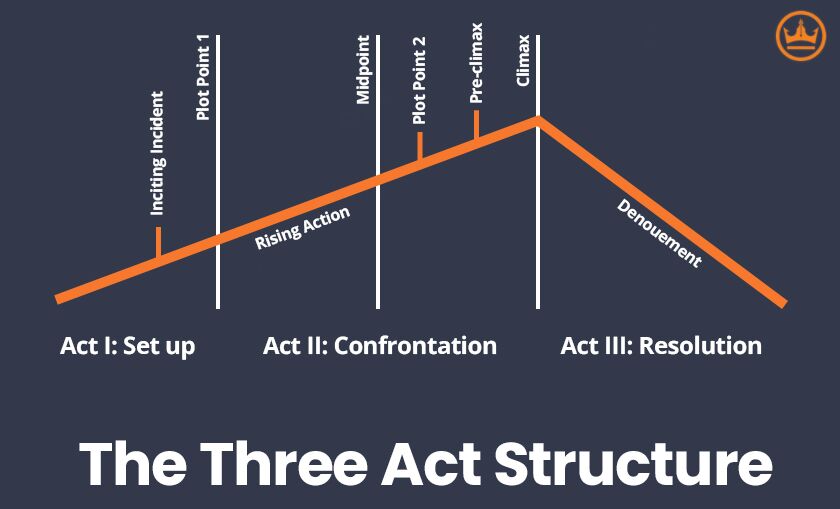
Act One, known as “The Setup,” introduces the protagonist(s) and the world they inhabit, setting the stage for the main conflict. This act typically includes exposition, familiarizing readers with the protagonist’s everyday life while hinting at an underlying conflict. The inciting incident, or “call to adventure,” occurs next, propelling the protagonist into the story’s main conflict (Chesson, 2023). Not every inciting incident is as exciting as a quest to save the world; some are as simple as accidentally walking into somebody (Heckmann, 2023, p.1).
In Act Two, or “Confrontation,” the protagonist faces escalating challenges and setbacks as they strive to overcome the main conflict. The rising action drives the protagonist toward the climax, with challenges becoming increasingly dangerous and the stakes rising accordingly. The midpoint represents a pivotal moment where the protagonist undergoes growth but faces a significant setback, prompting them to reassess their goals and motivations (Chesson, 2023).
Finally, Act Three, or “Resolution,” sees the protagonist confronting the antagonist in a final showdown. The pre-climax is characterized by a significant setback for the protagonist, often the darkest moment of the story, before the climactic confrontation. The climax represents the culmination of the protagonist’s journey, where they overcome their greatest obstacle using the skills and knowledge acquired throughout the story. The denouement, or resolution, ties up any loose ends and provides closure for the protagonist’s arc and any remaining subplots (Chesson, 2023).
The climax of the story is crucial as it engages the audience and fosters a sense of involvement (Shere & Traoudas, 2017). The more the storyteller is able to focus on a lesson learned, or a moral created, the more powerful the story can be (Pera et al., 2016; as cited in Sheri & Traoudas, 2017).
Overall, by applying the three-act structure and focusing on storytelling techniques, I aim to dissect the narrative elements of the PLUS commercial and uncover its underlying themes and messaging.
To add depth to my analysis, I will also incorporate semiotics, using the framework of Fischer-Lichte (1992). While I will not delve extensively into this aspect, there are several key elements within the commercial that contribute to the creation of meaning and conveyance of the message.
Three-act structure
Act I: Setup
In the opening scenes of the PLUS Christmas commercial, we are introduced to the protagonist, a young boy who arrives home after being dropped off by his friends. As he enters his house, his expression changes upon seeing unfamiliar large men’s shoes. The inciting incident occurs when he walks into the kitchen and unexpectedly witnesses his mother kissing a man. This moment kickstarts the story. His shocked reaction and his mother’s surprise indicate that she was unaware of his presence. The new man attempts to introduce himself, but the boy rejects the gesture, storming off to his room in anger and sadness, as portrayed by the slamming door and his emotional expression while looking at a photo of himself with his father.

Act II: Confrontation
Tension builds as the boy continues to struggle with the presence of his mother’s new partner in the household. He actively avoids interacting with him, and their strained relationship becomes evident through the escalating conflicts. The boy’s anger and frustration manifest in disruptive behavior, such as throwing snowballs at the man’s car and shouting at his mother. This is the rising action of act two, things don’t go smoothly (Chesson, 2023). There are challenges that are emotionally hard for him. Then the boy accidentally breaks the photo frame containing a picture of himself and his father, his stepfather sees this. However, a moment of reflection is triggered when the boy observes his mother and stepfather happily interacting outside, prompting him to reconsider his feelings.

Act III: Resolution
In the pre-climax, the stepfather returns the repaired photo frame to the boy with a new frame, symbolizing his love for his stepson. The climax unfolds as the protagonist rushes towards his stepfather, who embraces him, signifying the resolution of their conflict. This is a moment of acceptance of the boy, that he now has a stepfather in his life who can give him love. The denouement sees the boy joining his family at the dinner table, exchanging a nod of understanding with his mother. As they sit down to eat together, the loose ends are tied up, and the story concludes with the boy visibly happier and at peace, indicating the completion of his emotional journey.

Semiotic analysis
Music
There is emotional piano music, which builds up as the climax approaches. At the moment when the son and stepfather hug, there is also a release in the music. The music transitions from somewhat melancholic piano music to hopeful tones. Additionally, at the climax moment, you hear the lyrics: “You let my heart beat, let myself free, I keep dreaming it all.” The music, along with the song lyrics, helps give meaning to the scene with the son and the stepfather.
Mimic signs
The boy looks unhappily surprised when he sees his mother kissing her new partner and appears sad when he looks at the photo frame of his father and lies in bed.


Gestural signs
In one of the initial scenes, there is a significant moment where the stepfather attempts to introduce himself by reaching out his hand to the boy. This gesture signifies that they haven’t met before and that the new partner of his mother is new to their lives. Also, the scene where the son is shouting at his mother, he uses his hands to express himself. This gives meaning, because it shows that he is really angry in this moment.


Props
The photo frame with his father is a prop. If it were omitted, the story wouldn’t have the same meaning. It highlights the fact that his parents are separated, his mother has a new partner, and he struggles with it. The viewer understands this when they see the boy looking at the photo frame. Moreover, the photo frame becomes a recurring element throughout the story, as it breaks when he angrily slams his door due to his refusal to accept his mother’s new partner. Subsequently, his stepfather gives him a new frame with the photo in it. This action leads to the climax where they reconcile. Overall, the photo frame is a significant prop in the story.


Lighting
In the scene where the boy reflects in the school hallway, the lighting becomes very dark in the hallway, and you see him eventually looking up towards the light. The dark hallway can have a dual meaning, suggesting that his thoughts are also dark; he has been through a tough time and is emotionally burdened. When he looks up towards the light, it can have a dual meaning of acceptance of his stepfather. It’s as if he has a moment of realization, a point of change in his thoughts, his perspective towards his stepfather.

Conclusion
In conclusion, the Plus commercial effectively communicates its message of familial unity and reconciliation by employing a combination of storytelling techniques and semiotic elements. By structuring the narrative around the three-act framework, the ad guides viewers through the protagonist’s emotional journey, from initial resentment towards acceptance and reconciliation with his stepfather. The use of emotional music, facial expressions, gestures, props, and lighting further enriches the storytelling, imbuing each scene with depth and resonance.
The message of the ad is constructed in a deliberate manner to evoke empathy and emotional connection from the audience. The three-act structure establishes a clear narrative arc, allowing viewers to empathize with the protagonist’s journey and ultimately root for his reconciliation with his stepfather. Additionally, semiotic elements such as music, facial expressions, and props are essential in creating meaning and reinforcing the ad’s message of unity and togetherness.
Overall, through the strategic use of storytelling techniques and semiotic elements, the Plus commercial effectively communicates its message while fostering emotional connections with its audience. By addressing contemporary societal issues and emphasizing the importance of familial bonds, the ad resonates deeply with viewers and reinforces the brand’s commitment to promoting unity and togetherness during the holiday season.
This content expression fits seamlessly into the broader “Goed eten is samen eten” campaign by Plus, which emphasizes the joy of sharing meals with loved ones. By showcasing the challenges and eventual reconciliation within a family, the ad adds depth to the campaign’s message, highlighting the importance of overcoming differences and coming together, especially during festive occasions. In doing so, the commercial not only accomplishes the brand’s goals of promoting its products but also effectively communicates its purpose of fostering familial harmony and togetherness, thereby enhancing the overall impact of the campaign.